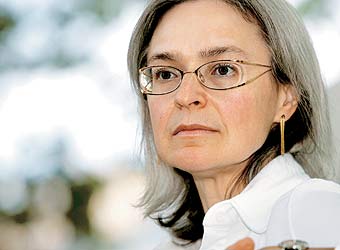
Friday, February 16, 2007


Something To Think About
islam in america

Friday, February 09, 2007


OUR DEEPEST FEAR

"Our deepest fear is NOT that we are inadequate. Our deepest fear is that we are powerful beyond measure. It is our light, NOT our darkness that most frightens us. We ask ourselves, 'Who am I to be brilliant, gorgeous, talented, fabulous?'; Actually, who are you NOT to be? You are a child of God. Your playing small does not serve the world.

There is nothing enlightening about shrinking so that other people won't feel unsure around you. We were born to make manifest the glory of God that is within us. It is not just in some of us, IT IS WITHIN EVERYONE! As we let our own light shine, we unconsciously give other people permission to do the same. As we are liberated from our own fear, our presence automatically liberates others."

- Nelson Mandela


This really spoke to me as I read it. Read it again and again until it gets into your very being. Allow it to build your self-confidence. May God bless you today!

Love, Tammy Faye


Without a doubt Tammy Faye is one of the
Great Women of God that this generation has seen.
It truly is never over until it is over.


Tuesday, January 30, 2007


Juan Mann - One Love
this is the one that started it all . . .

Sunday, December 31, 2006


Stephen Baldwin Brings Back Some Old-Time Religion— with a Book and Reality TV

September 05, 2006 - By Kimberly Maul


The youngest Baldwin brother has taken a path his famous siblings are hardly known for: passionate, loudly voiced religious beliefs and conservative political leanings. Now Stephen Baldwin, a Republican—no relation there between him and old-school liberal, big brother Alec Baldwin—is speaking out with a heartier mission than ever, with The Unusual Suspect: My Calling to the New Hardcore Movement of Faith.

Warner Faith will release the book on Sept. 19. Stevie B., as he likes to call himself, is known for his role in The Usual Suspects, Bio-Dome and two seasons of Celebrity Mole. But after he turned to Christianity soon after Sept. 11, 2001, the actor’s focus shifted. He eventually founded Livin’ It, a tour featuring extreme sports and well, extreme evangelism. It has spawned DVDs, books and a clothing line. “My ministry is motivated to hopefully change the way the youth culture thinks about what it means to be a person of faith,” Baldwin said. He mentions hardcore music, extreme sports and “gnarly” people as means that separate his ministry apart from other Christian programs. And “the same goes for the book,” the actor-cum-preacher told The Book Standard recently.

The Book Standard:
Why did your book come about?

Stephen Baldwin:
I’m so blown away with the experience that I’ve been having in this connection that I’ve made to God, that I thought it would be fun to put it into my own words. Also, it was the perception of many of my friends and family that it might bless some others.

TBS:
Are you hoping Christians will read the book or were you writing for people who don’t share your beliefs?

SB:
Well, it’s really for everyone. My prayer for the book is two-fold. I pray that people who don’t have a relationship with God will close the back cover of the book and say, “If this guy, for who he is and where he’s from and what he’s experienced so far, if he’s having this much fun in his walk of faith, then maybe I might become willing to consider it.” I tell people all the time, when God called Stephen Baldwin potentially to faith, he didn’t want me to stop being Stephen Baldwin, he just wanted me to stop sinning to the best of my abilities. So that’s one thing. And then for the Christians who read the book, the thing that I wanted, hopefully, is [to ask] are they sure that they are following their true calling? Have they gone through a certain process of really going into prayer and reading the Bible and going before God and saying, “What is your will for my life?” Because that is what I did and the answer freaked me out in a very positive way.

TBS:
Would you classify The Unusual Suspect as an autobiography or more of a religious book about Christianity and the “hard-core” movement that you associate with?

SB:
Well, I jokingly call it “The Gospel According to Stevie B.” I said some things in the book that I’m getting a lot of flack about—people are saying, “Well you can’t talk about sex and you can’t talk about this.” Well, as long as it’s sex with your wife and as long as it’s within a decent taste [it’s ok]. I’m sick and tired of being sick and tired of the Christian movement being so stuffy and farty. The whole thing’s gotta relax. It’s the reason why people are so against it here in America.


TBS:
How do you feel about the media fixating on things like your “bringing God into your marriage,” which is what the media calls “threesomes with God”?

SB:
The media is usually trying to sell something, whether it’s a newspaper, magazine or whatever. I’ll be honest with you. Don’t think that I didn’t know when I was writing the book with Mark Tabb, that there were moments when I looked at him and said, “Should I say that?” And he went, “Go for it!” Meanwhile, he’s not the one that’s going to get beat up in the media. For me, I’m interested in sharing my experience, being who I am, hopefully not getting in too much trouble in the process, although that’s a little bit of fun now and again. So, that’s part of where I’m coming from in the book, part of what I’m doing. I’m trying to shake it up a little bit without getting out of hand.

TBS:
How has your family reacted to your outspokenness about your faith?

SB:
Everybody’s been pretty cool so far. Again, that’s because I don’t sit there and beat anybody over the head. I don’t know which Christian leader said this—gosh, I hope it wasn’t Jesus, I should know that is what I’m saying—“As often as you can, preach the gospel. And when absolutely necessary, use words.” I know that’s a bit of a cliché, but I really believe that walking the walk to the best of your ability as opposed to talking that talk, unless when it’s necessary. I have been outspoken, but in certain Hollywood situations or in social circles, I know when I walk in a room that everybody’s thinking, “Oh there’s the Jesus freak.” And my response then, in my heart is “Amen! You’re right! Absolutely!” And I don’t apologize for it. At the same time, when I’m standing there, people come up to me and they’re curious because somewhere in their hearts, most people are searching. And they want to have that satisfaction in life. They want to be absolutely certain that who they are and where they are at answers the question “What’s life all about?” And for me, I’ve found that answer. It’s an exciting time for me. And that’s about to becoming very exemplified in a new VH1 reality show I’m doing later this year.

TBS:
What will your new VH1 reality show be about?

SB: I met with the president of VH1 recently to pitch him another reality concept for a show and I was there with my manager and my producing partner and this gentleman started asking me questions about my walk of faith and what I’m doing. I’m in there for one thing and I came out of there—this is six months ago—entertaining the notion of doing Stephen Baldwin as a reality show about launching my own ministry for next year. It’s a done deal, the show’s going forward. But we don’t know what the name of it is going to be or anything like that. So, right now it’s kind of in development. It’s exciting too to do a kick butt rock-and-roll ministry concept for VH1.

TBS:
What will the ministry that will be the focus of the show be like?

SB:
It’s going to be Living’ It on steroids, basically. It’s going to be an arena tour and it’s just going to be really a production that will be similar to Tony Hawk’s skate tour, with some really kick butt Christian rock-and-roll bands. A lot of the Christian festivals today have an element of hardcore, but even that is in the minority. With this tour, called the Uprising Core Tour, I want it to be this thing that is legitimate to the street and can compete with Ozzfest or any of that stuff. I want it to be something where kids who are believers or nonbelievers can come to an arena and can have an entertainment experience that is just as fun as the other stuff out there, but you’re going to get this positive message somewhere in the experience.

TBS:
What was your favorite movie to work on in your past?

SB:
Underneath it all, I’m really quite a goofball. With that in mind, The Flintstones was really the most fun I had on a movie. It was just a blast. Barney Rubble, in my youth, was one of my heroes, so obviously the opportunity for me to recreate that on that kind of a scale and make it believable was very challenging. I can’t tell you the number of kids every month that stare at me on line at a Stop & Shop and they’re kinda looking at me from the corner of their eye and when the mom or somebody says, “Oh, he’s an actor.” I’ll say, “Have you seen The Flintstones in Viva Rock Vegas?” They just flip out. It’s just the cutest thing.

TBS:
Do you regret any of your movies?

SB:
Well sure, there were some pictures [I regret]. What I pride myself on, as far as the choices I’ve made in my career, is that I met the director, I met the writer, I met the producers and what initially seemed like a really good effort, didn’t always come out that way. I’ve been very blessed. I’ve made over 60 movies in a little over 15 years and I’ve done way more work. I’ve been very fortunate to succeeded as much as I have. I joke around and I tell people, when I was growing up, I should probably still be on a lifeguard stand somewhere on Long Island. God’s been very good to the Baldwin family and I consider it a blessing. For me, sure, there’s probably two or three of those suckers in there that in retrospect, I might not have done. But it all happened for a reason, so I’m cool with it.


Saturday, December 23, 2006

Move over George Bailey . . .


The is a lot of "things to talk about" in this film. You got to love Sly. The greatest film I have seen since The Nativity Story. Rocky has had a "Wonderful Life" too. 10 thumbs up!

Tuesday, December 19, 2006


Wise Men Still Seek Him!
The Nativity Story

10 thumbs up!


Monday, November 27, 2006

Ted Haggard's Thanksgiving
By Deborah Anderson - The Vashon Loop

It was a tough call at election time whether Ted Haggard’s gay affairs or Sadaam’s death sentence were going to be the pop culture swing vote. I feel really sorry for poor old Ted.

Really I do.

For those of you who see yet another Christian clergy taking a dive on walking the walk as the excuse to bow out of being a part of a faith community, let me let you in on
a secret. Clergy sexual misconduct is as common as kids learning to ride a bike. If the protestant church ever truly reveals it’s occurrence, it’s going to make those Catholic priests with their little boys look like teacher of the year. Really.
There was a time when I thought if I’d heard one more minister confess his insincerity in service or sexual addiction, I was
going to encourage everyone to play golf on Sunday. It’s just so annoying. I mean, for heaven’s sake, Grace is one of the all time gifts of eternity. Why on earth would a person spend all that time in church meetings and never actually get to enjoy the privilege of the freedom, peace, joy, love and sheer fun and adventure that comes from walking the Christian walk?
Actually, there’s a very important study that was done that showed that most pastors were not in the ministry because
of God, but because they enjoyed being worshipped. They weren’t very good at social intimacy and being a pastor gave them the distance from that little skill they needed. So what?

So, pastors’ screwing up (pun intended) is no reason to
ignore God and all the blessings God bequeaths us. Throwing the baby out with the bathwater is silly. Rabbis and Imams are just as human. In fact, God’s biggest challenge has been getting the message of love and forgiveness to the laity despite the fact that some of his highest profile ambassadors are really bad at representing God’s message.

As you push back from the Thanksgiving groaning board and prepare for the race to the New Year, may I make one suggestion (Why , of course, Deborah. Please do. I heard you say)?

Make this the season you rediscover God. Knowing you are loved by God is the best present anyone can receive. We celebrate two great truths about God in the next six weeks. First of all, that God will always protect us and supply our needs. If you’re in a time when you doubt that truth, look for the eight days worth of oil in your life.
Secondly, you don’t have to do a thing about earning God’s love. It’s a free gift. All you have to do is acknowledge it. Say yes to being in a relationship with God. That’s the starting point. This season is a time of faith renewal. Share the love God has poured on you with others. Pray for those who stumble. Ignore those who would take you out of God’s love and care. Take time each day to deepen the faith you have.


And to start with, Happy Thanksgiving.

Friday, November 17, 2006

An Absence of Awe
By Chris Seiple
President of the Institute for Global Engagement

November 1, 2006


“For if you remain silent at this time, relief and deliverance of the Jews will arise from another place…who knows but that you have come to royal position for such a time as this?”

Esther 4:14


Next week we Americans will go to the polls and vote amidst uneasy and trying times. Abroad, the world appears to be going to hell-in-a-hand-basket. From nukes in North Korea and soon Iran, to the seeming morass of Iraq, to the threat of terrorism, we are physically threatened.

At home, both political parties provide simplistic positions to motivate their base while avoiding complex issues. Indeed, among the people I talk to, Republicans are repulsed by their leadership’s inability to speak clearly on torture, to be honest about Iraq and Congressional scandals, and to spend taxpayer dollars responsibly; while Democrats are disgusted by their leadership’s inability to provide a viable alternative. The result is two parties defined against each other — instead of by what they are for — serving no one, not even themselves.

It is no wonder that perceptions of America abroad, and American perceptions of politicians at home, are at all time lows.

Yet Christians belong to both parties, and are therefore a part of the problem. Is it possible that we Christians, who are called to a “more excellent way,” can set a different tone for our country — individually and corporately — no matter our political differences?

I think the answer is yes. But we have to overcome our “absence of awe” for God and the way He works his will in human affairs. This absence is often particularly evident in our conduct toward one another in political life — a conduct that loudly proclaims that we feel we are the center of the universe and that we are more important than our neighbor.

If Christians who happen to be Americans are called to love their neighbor during this election season, then we must forge ahead by recovering our awe for the living God of history, and the gifts He has given us, especially the stewardship of our democracy. Fortunately, God provides some principles for living shrewdly amidst geopolitical complexity and local politics through the example of Esther.

Esther, a Jewish orphan in exile, grew up in Persia (Iran) during the 5th century B.C. Raised by the devout Jew, Mordechai, she won a national beauty contest as a young woman and became the wife of King Xerxes, and Queen of Persia. However, the King’s senior advisor became angry with the Jews because of Mordechai’s devout example. He then planned, and won the King’s approval for, genocide against all the Jews throughout Xerxes’ Middle East kingdom. Esther shrewdly used her influence to not only defeat the advisor, but protect and preserve — through the rule of law — her minority faith’s right to worship freely.

This remarkable result hinged on Mordechai’s challenge to Esther (cited above). Christians can interpret and apply this challenge in one of two ways. The first manner is selfish, focusing only on that famous phrase, “for such a time as this.” By considering this last part of the verse in isolation, Christians over-spiritualize allegedly unique moments, seeing what they want to see. As a result, any collection of coincidences becomes an opportunity to see God’s hand of validation — from our desire for parking spaces to personal prosperity to our political positions. The created, not the Creator, is the point of reference.

The second interpretation is not afraid to claim the phrase “for such a time as this,” but it does so only in the context of Mordechai’s admonition at the beginning of the verse: If not you, Esther, “deliverance for the Jews will arise from another place...”

Interpreted in its complete context, the Creator is now the point of reference. God will provide for the Jews ... because He can. God is sovereign. He does not need you, Esther, but this is a chance for you to be obedient. Esther, this is a chance for you to steward the gifts and opportunities that God has given you for His sake, not yours.

Esther understands the moment, and moves intentionally against the policy of genocide. Curiously, she does not organize a simplistic advertising campaign that misconstrues the facts or insults the opposition.

Instead, Esther fasts.

She waits upon God for wisdom and discernment. With the resulting peace, and insight, she tricks the King’s advisor — who considers the moment as “such a time” for his own political gain — into moving too quickly. He hangs himself politically, and then is hung by the King for his treachery.

Most intriguing about this account is the fact that the name of God is not mentioned once in the entire book of Esther. It doesn’t need to be. His name is revealed and revered not so much by what Mordechai and Esther do — or even say — but in how they do it. His voice still speaks to us today through their character, through their relentlessly redeeming example of faithfulness, humility, and obedience.

It is a voice that we Christians would do well to remember as we consider the example we set for each other, and the world:

The voice of the Lord is powerful;

The voice of the Lord is majestic.

The voice of the Lord breaks the cedars ...

The voice of the Lord strikes with flashes of lightning.

The voice of the Lord shakes the desert…

The voice of the Lord twists the oaks and strips the forests bare.

And in His temple all cry, “Glory!”

...the Lord is enthroned as King forever. (Psalm 29:4-5, 7-10)

Does the living God of history speak through your example? Do your words and actions reflect a profound awe for the Creator of the universe? Is your life, to the best of your human ability, an honest attempt to be obedient — where “such a time as this” is reverentially revealed in every moment of a life humbly spent seeking the face of God? Is He the point of reference, not you?

Or, is “such a time as this” a chance to validate your political position, as well as your latest efforts to gain wealth, prestige, and influence?

There are no easy answers and, truth be told, most of us, beginning with me, spend the majority of our time validating our selfishness.

So here’s a suggestion for my fellow American Christians: fast.

Sometime before the election, find the time to fast, and seek the face of God. As you fast, listen for His voice. Seek wisdom and discernment about how best to love your neighbor in these complex and divisive times, as you also steward that gift from an awesome God that is your American citizenship.

(c) 2006 The Institute for Global Engagement

Saturday, November 11, 2006

In Their Own Words . . .


"Why I Chose Jesus"
by J. Dudley Woodberry and Russell G. Shubin

A survey of Muslim-background believers gives the Christian community an opportunity to hear what fellow Christ-followers found attractive in Christ-centered faith.


THE SCOPE OF ISLAMIC INFLUENCE on the world seems to be growing. Images of Islam are increasingly prevalent. Nine states in Nigeria, Africa's most populous statehave just adopted Shariaor Islamic law. Public demonstrations of devotion in Islam can be seen throughout the world. Given the dedication evidenced by faithful public prayer, one may not be unwarranted in presuming that both satisfaction and allegiance run high.
Yet, in nearly every corner of the world, even in nations that have an overwhelming Muslim dominance, people from Muslim backgrounds are coming to faith in Christ. Exact figures are elusive. In some areas a shift of allegiance to Christ is happening on a fairly grand scale, with bold, public professions of faith. In many other places, believers in Christ live very low-key lives, using great discretion as to whom they disclose their faith commitment. Increasingly prevalent are the small, secret groups of a few faithful followers that meet on a regular basis, sometimes not disclosing their new-found faitheven to their family.

Between these two extremes, followers of Isa (the Qur'anic name for Jesus) meet and worship in a variety of other contexts and worship in a number of different forms. These quiet practitioners, as well as the prevalence of governments predisposed against any shift in religious affiliation, make it difficult to state definitively how many have proclaimed new-found faith in Christ.
The centerpiece of their faith, however, is the same. They havewhether one by one or family by familybeen drawn to the God-man Jesus Christ. And for their spiritual direction, they have found one book that stands out above all others: the Bible. And more than any other portion of scripture, these believers are attracted to the Sermon on the Mount.

One Javanese man who read the whole Bible echoes the thoughts of many about the Sermon on the Mount, saying, "If the life of a Christian is like that, I wanted to become a Christian."
The fastest growing religion In a number of respects, Islam actually is growing faster than Christianity. Islam's growth rate of 2.15 percent annually does exceed Christianity's rate of 1.45 percent. It is worth pointing out, however, that 96 percent of the growth of Islam is attributable to biological growthchildren born into Muslim families. Islam is flourishing in parts of the world where population growth is high. Christianity, increasingly decentralized, has its traditional base in parts of the world where population growth is quite slow or has come to a standstill. Thus, the overall trends do show Islam growing faster than Christianity.

Conversion growth is where you find quite a contrast. According to figures presented in the 2000 edition of the World Christian Encyclopedia, each year some 950,000 people convert to Islam from some other persuasion. Christianity, by contrast, sees some 2.7 million each year shift their affiliation to Christianityand presumably their allegiance to Christ from some other religion.
But a broad pattern is obvious: people that live in Muslim-dominated lands pay a heavy price for placing their faith in Christ. Family members, in particular, can exert tremendous pressure on a new believer. The place of persecution is considered at more length later. Suffice it to say that the believer from Jordan who was permanently cut off from his family is not really an extreme example. His father had recently died. He was informed that he, too, was considered dead. When we consider the price that is frequently paid by those who have come to faith in Christ, a natural question comes to mind:

What was it about Jesus or the Christian faith that they found to be sufficiently compelling, making them willing to pay such a heavy price? What has God's Spirit used to reveal to them that He is worthy of following, regardless of the price?


The question is really quite simple, but relevant for the missionary and the common devotee of Jesus alike.
During the past ten years, an extensive questionnaire compiled at Fuller Theological Seminary's School of World Mission has been filled out by some 600 Muslim-background believers (or those who knew them well). The results provided here are drawn from a representative sample of 120 of those surveys. The respondents are drawn from 39 countries and over 50 ethnic groups. They provide a broad window into the hearts and minds of those who have turned from Islam to Christ. In a number of cases, the responses surveys substantiate what missionaries have often thought. In other cases, what these new believers have found compelling is somewhat unexpected and eye-opening.

Most frequently, there is a healthy sense of awe as one gains first-hand appreciation of the tools the Spirit has used to draw people to faith in the crucified and risen Savior.
What follows is essentially a summary reportan opportunity to let the heart of the convert be heard. An effort has been made for it not to be why they should or ought to have been drawn, but rather why they say they were drawn. Most of the prominent factors for conversion are interrelated. At times, people would express a great number of these subjects as factors in their conversion. In the end, they serve as complementary components that contribute to making a relationship with Christ irresistible. A sure salvation It is an issue that touches on a longing concern for much of humanity. The question of one's eternal destiny haunts many who long for the hope of heaven and the sure knowledge that they have been saved from the penalty of their sins.

The Qur'an states that salvation belongs to "those that believe and do deeds of righteousness, those are the inhabitants of Paradise, there they shall dwell forever."

1 Yet it also states that God forgives whom He wills and chastises whom He wills.

2 In practice, then, the sure hope of salvation looms at least a bit elusive for many, even the most devoted Muslims.
One Indonesian woman was taught in her Islamic family that the bridge to heaven was as thin as a piece of hair. This tradition is found in the canonical collection of the activities and sayings of Muhammad (the hadith). Even good deeds, she was taught, would not assure her of crossing safely into Paradise. This hair-thin bridge was difficult and dangerous to cross. For her, a key factor in coming to faith in Christ was the realization that she could not save herselfonly the blood of Christ could redeem her.

A West African woman wanted to know for certain at the point of her conversion that her sins had been forgiven and washed away. When a Persian émigré to the United States was asked if Christ had given him freedom from fear, he said, "Oh yes, I feel more forgiven, more assurance of forgiveness." For these and others, what they have found in Christ is an eternal, secure refuge. An Egyptian man stated more broadly and unequivocally that the main attraction of Christianity for a Muslim is the assurance of salvation. A Javanese man said simply, "After
I received Jesus, I had confidence concerning the end of my life." Jesus While Christ is the clear centerpiece of the new-found faith of all Muslim converts, in some respects the person of Jesus can be recognized as the particular cause and most persuasive attraction. Simply put, Christ's character is frequently seen by the Muslim as overwhelmingly attractive. A Pakistani immigrant to the United States was particularly attracted by Christ's refusal to retaliate when maltreated. This man notes that "he bore it, he never retaliated." Even though almost all Muslims believe that Christ was not crucified,

3. the Qur'an certainly accepts His opponents' intention to kill Him and His willingness to die thus.
So the report of a Persian who says he was attracted to Christ before he was attracted to Christianity is not an anomaly for Muslims. Christ is revered in Islam. There are a number of passages whose meaning is disputed, but Christ is, at minimum, seen as a prophet.

4.
A West African man was drawn by the humility of Christ and the revelation that Christ was not tainted by sin. Though it often goes unmentioned, Christ is portrayed in the Qur'an as being without fault.

5. Muhammad, in contrast, is told to ask forgiveness for his sins.

6. When asked what particular teachings of Christianity attracted him, an Egyptian man stated simply, "the crucified Messiah."
A holy book: the power of the Bible The Torah, the Psalms (Zabur) and the Gospel (commonly understood as the New Testament) are all revered by Muslims as holy books. Though many are unfamiliar with the content of scripture, they find it quite compelling once they begin to read. For one Lebanese Muslim, Christ's teaching in the Sermon on the Mount was most instrumental at the point of his conversion. A North African believer was touched by Christ's love for the poor, the downtrodden, the outcast. Another man was attracted by these qualities in Christ's followers.

He saw Christians as the only people who care deeply about justice for the poor and oppressed.
Then you will know the truth. Others have finally found in the Bible a truth that they found to be plausible. In searching the Bible, one Pakistani believer found answers to many questions that had concerned him. After his appreciation for the Bible grew, he felt he had been deceived by those who taught him that the Bible had been corrupted. A North African found in the Bible teaching that was plausibly the truth, and it satisfied him intellectually. An Egyptian who came to faith in Christ found that the Bible helped him see the true character of God. He had growing doubt about the Qur'an, but the Bible, he said, was "powerful and satisfying."

Similarly, an Iranian says, "The Bible makes sense, it is reasonable and logical; it is relevant and not culture-bound."
I have had a dream For someone who has not had extended exposure to Muslim-background believers in Christ, probably the most striking surprise is the powerful role that dreams and visions have played in drawing people to Jesus. Though dreams may play an insignificant role in the conversion decisions of most Westerners, over one-fourth of those surveyed state quite emphatically that dreams and visions were key in drawing them to Christ and sustaining them through difficult times.

Rick Love, International Director of Frontiers, has recognized the pattern as well. He writes that, "Just as God used a vision to convert Paul, in like manner He reveals Himself to Muslims through dreams and visions. Just as God prepared Cornelius to hear the Gospel through a vision, so God is preparing a multitude of Muslims to respond to His good news."7
One believer from Guinea recounts the dream of a figure whom he later believed to be Christ. The figure was in a white robe, calling the man to come to Him. In a related dream, he recalls that the same figure's arms were extended, beckoning him.

Dreams of this type have become recognized as a pattern of work among Muslims. Though there are variations, Christ appearing in a white robe is a recurring image among those who have had dreams and visions. Similarly, a Muslim Malay woman was drawn by a vision she had of her Christian parents who had died. She saw them rejoicing with others in heaven. Jesus, appearing in a white robe, said, "If you want to come to me, just come." Feeling that she had tried her entire life to reach God without success, she now saw God initiating the effort to reach her through Jesus.
A convert from the Middle East who had been afflicted with severe headaches was lying on his bed after having prayed for his sick son. A man with a beautiful, peaceful face appeared. Dressed in white, the figure walked to the head of the man's bed and touched him three times on the head.

The next morning his headaches were gone. His son, too, was fully healed. Understandably, he now recounts with confidence, "I believe in prayer in the name of the Christ."
The great majority of dreams seem to fall into one of two broad categories. The first could be considered the preparatory dream. Like Christ appearing in a white robe, the vision confirms thoughts or conversations one has been having about Christ or the Christian faith. The second could be called the empowering dream. Here the dream or vision commonly gives the believer strength in the face of persecution. Short of persecution, it may embolden believers, strengthening the nature of their witness. Preparatory. One Sunni woman from the Arabian Peninsula had a figure appear to her in a dream, telling her to visit a Christian woman she knew. The figure, who she was later convinced was Christ, told her this woman would teach her. Prior to his conversion, a Persian man had a vision. In it, he was falling in darkness over a cliff and was saved by a light holding onto his back. In a fascinating twist on God's use of dreams and sleep, one Algerian recounted how she heard her sleeping Muslim grandmother say, "Jesus is not dead. I want to tell you He is here."

A West African man recounts a succinct, yet powerful vision he had prior to conversion. He saw a devout Muslim in hell and a poor Christianwho couldn't afford to give almsin heaven. A voice explained to him that the difference was belief in Jesus.
Empowering.

A North African believer found the needed strength to face his imprisonment from a dream he had while imprisoned for his faith. In it, he saw thousands of believers pouring through the streets of his city, openly proclaiming their faith in his restricted country. While in prison, he was tortured, suspended upside-down naked for hours, beaten with electrified rods and repeatedly threatened with execution. His vision of a day when people of his country would openly proclaim their faith in the streets gave him great strength to persevere through this most difficult time.
Encounter. Though not strictly a dream or a vision, a number of Muslim-background believers have had a significant supernatural encounter that was instrumental in drawing them to Jesus.


One Egyptian Muslim was reading the Injil (Gospel), when he came to Luke 3, where the Holy Spirit descended on Jesus in the form of a dove. God said, "This is my son, in whom I am well pleased." As he read those words, a stormy wind broke into his room. A voice spoke to him saying, "I am Jesus Christ, whom you hate. I am the Lord whom you are looking for." He recalls that he "wept and wept, accepting Jesus from that time."
Whatever personal perspective one has on dreams and visions and the Christian walk of faith, it is difficult to consider engaging in ministry to Muslims without a recognition of and an openness for God to continue drawing people to Himself through what may be viewed as unconventional means.

The greatest of these is love
By far, the reason found most compelling for the greatest number of Muslims who have turned to Christ is the power of love. Like Paul, many a believer from a Muslim background has found that "the greatest of these is love." Nearly half of all Muslims who have made a shift of faith allegiance have affirmed that the love of God was a critical key in their decision. By this all will know that you are My disciples, if you have love for one another. Love's attraction could be simplified into two subcategories. The first is love by example. One Jordanian believer attributes his conversion to "the unconditional love and the aura of peace and contentment" that he saw in his Christian friend. An Arab émigré to France, describing the friendliness of her Christian acquaintances, says they "radiated the beauty of Christ." These friends, who had emigrated before her and given their lives to Christ prior to her arrival, prayed that God would answer her prayers for a job. She says she has been amazed at how "the Lord has continued to answer prayers."

This young Sunni Muslim woman saw a kindness and experienced an intimacy with her believing friends that made her believe that God, too, could be her friendand give her eternal life. Admittedly, it is difficult to separate the example of love demonstrated by believers and the witness of scripture, testifying of a God of love.
God's love. A second category of love is that which is demonstrated directly by God and evidenced in scripture. One Bengali man says he was "subdued by the revelation of God's great love, his own sinfulness, and Christ's great sacrifice for him." A West African from Gambia explains simply that "God loves me just as I am." He described his experience in Islam as "rigorous submission to God." He sensed an inability to please God. Though he was stoned for his faith in Christ, he remains faithful to his new life in Christ. The love of God is particularly poignant for Muslims who may have been suppressed by other Muslims. One Shi'a man was attracted by the truth that "God loves all people"and that he was personally loved and protected by God.

Similarly, a West African was surprised by God's love "for all people of all races, including enemies." His experience in Islam convinced him that Arab Muslims are racist towards Black Africans. Sadly, he described Islam as a "tool used by Arabs to oppress non-Arabs."
I have called you friends: relationship with God For some 10 percent of Muslim-background believers, the particular attraction of a relationship with God was the strongest apparent factor in their conversion. The Algerian émigré mentioned earlier was taken by the fact that God could be a friend and a father. Similarly, a North African convert was drawn by the opportunity to have a direct relationship with God. What he felt he lacked in Islam was any proximity or nearness to Godthere was no possibility of walking together with God. In Christ, he stated that a very strong attraction was a direct relationship between the Lord and the people. In a sense, the veil of separation had been lifted. An Egyptian believer stated two compelling reasons for his attraction to Christianity: being adopted as God's son and the Holy Spirit dwelling in him. This reflects positively what one Indonesian states negatively about Islam: "God is universal and has no family. There was no way of knowing what God was like."

North American evangelicalism has been criticized for its emphasis on the experiential, the personal. In light of the testimony of this cross-section of Muslim-background believers, the opportunity for access and relationship to God is not an appeal unique to North Americans. Instead, one lesson from this cross-section of fellow Christ-followers from a Muslim background may be the universal appeal of what has been called a Divine romance: Christ's love for His Church and His desire to commune with those whom He has called His own. Blessed are those who are persecuted for righteousness' sake Some refer to it as the eighth beatitude. Others consider it more simply the by-product of living out the preceding beatitudes. However you view it exegetically, in practice it is clear that those who are coming to faith from within the Muslim sphere are much more likely to be intimately acquainted with persecution than those from the Western world. A West African believer was burned and stabbed by his own family. Though he was not killed, his family now considers him to be dead. Though the physical suffering is great, the psychological wounds that are inflicted on those who have been counted as dead may be underestimated.

A North African man found it difficult to overstate how traumatic it was for him as he was rejected and beaten and left homeless. Sadly, the national church did not accept him either.
B. Condit After his conversion, one Lebanese Muslim lost all of his teaching and professional privilegesand eventually was murdered. Other professionals, who had grown accustomed to some degree of esteem, are set back by the disdain they experience as a result of choosing to follow Christ. "Traumatizing" was how an observer described one Arab North African's experience of being arrested, interrogated and held by police for two days. For those who have been subject to persecution on the basis of their ethnicity, the persecution for their new-found faith comes as less of a surprise and actually serves to confirm their decision to leave their former faith. The North African who found Christians to be the only non-racist people he knew was intimately acquainted with severe persecution. His brother and several close friends have been murdered.

A West African man had his house burned and he was chased by people who were attempting to kill him and his family.
A fisherman from the Philippines expressed an increase in persecution, with people stealing his boat, cutting his nets and tormenting his children. Yet, an observer notes, "he is not shaken." This steadfastness in the face of persecution illustrates, at least in part, the role that persecution has played. If it does not actually spur numerical growth, it certainly seems to spur the growth of the soul, creating, so to speak, bigger Christians as a result of difficult, even horrendous treatment by the majority Muslim community. In the face of persecution, the comfort of scripture has provided profound help in time of need. One Javanese brother found courage to face persecution in Matthew 5:11: "Blessed are you when they revile and persecute you, and say all kinds of evil against you falsely for My sake." The teaching of Christ reoriented his perspective and he began instead to consider it a blessing. He noted that it was the exposition of Matthew 5:11 at a church service that was instrumental in his coming to Christ.

An Egyptian believer received similar comfort from scripture when he was being spit on and suffering death threats. The taunters told his younger brother he was an infidel. Yet, when he read the Gospels, he felt the love of God, sensing the presence of Jesus. A contrast to the Qur'an, he found the Gospels powerful and satisfying.
God is at work In this relatively brief look at what God is doing in a very large cross-section of humanity, we see His heart being conveyed in dramatic ways. Christ's hand is extended to Muslims in a way no less sincere than His hand has been extended to you. We don't appreciate being known for our worst manifestations. Muslims, too, ought to be given the benefit of the doubt. Many are seeking to follow God as best they understand Him.

Sincerity may not be the measuring rod for truth, but sincerity of heart is a critical foundation for a life of saving faith in Christ.
Dreams and visions may have been used by God in part because there is a dearth of flesh-and-blood witnesses for Christ willing to articulate and demonstrate the power of the Gospel in person. If nothing else, the preceding testimonies of these witnesses for Christ show that God is at work. Apparently, when Muslims do have an opportunity to see the love of Christ revealed in all its fullness, they are finding a life with Christ quite compelling. After all, grace does have an irresistible quality to it.

Monday, November 06, 2006

This is no time to "shoot our wounded"


My Dear New Life Church Family
November 5, 2006


I am so sorry. I am sorry for the disappointment, the betrayal, and the hurt. I am sorry for
the horrible example I have set for you.

I have an overwhelming, all-consuming sadness in my heart for the pain that you and I
and my family have experienced over the past few days. I am so sorry for the circumstances that have caused shame and embarrassment to all of you.

I asked that this note be read to you this morning so I could clarify my heart's condition
to you. The last four days have been so difficult for me, my family and all of you, and I have further confused the situation with some of the things I've said during interviews with reporters who would catch me coming or going from my home. But I alone am responsible for the confusion caused by my inconsistent statements. The fact is, I am guilty of sexual immorality, and I take responsibility for the entire problem.

I am a deceiver and a liar. There is a part of my life that is so repulsive and dark that I’ve
been warring against it all of my adult life. For extended periods of time, I would enjoy victory and rejoice in freedom. Then, from time to time, the dirt that I thought was gone would resurface, and I would find myself thinking thoughts and experiencing desires that were contrary to everything I believe and teach.

Through the years, I’ve sought assistance in a variety of ways, with none of them proving
to be effective in me. Then, because of pride, I began deceiving those I love the most because I didn’t want to hurt or disappoint them.

The public person I was wasn’t a lie; it was just incomplete. When I stopped
communicating about my problems, the darkness increased and finally dominated me. As a result, I did things that were contrary to everything I believe.

The accusations that have been leveled against me are not all true, but enough of them are
true that I have been appropriately and lovingly removed from ministry. Our church's overseers have required me to submit to the oversight of Dr. James Dobson, Pastor Jack Hayford, and Pastor Tommy Barnett. Those men will perform a thorough analysis of my mental, spiritual, emotional, and physical life. They will guide me through a program with the goal of healing and restoration for my life, my marriage, and my family.

I created this entire situation. The things that I did opened the door for additional
allegations. But I am responsible; I alone need to be disciplined and corrected. An example must be set.

It is important that you know how much I love and appreciate my wife, Gayle. What I did
should never reflect in a negative way on her relationship with me. She has been and continues to be incredible. The problem was not with her, my children, or any of you. It was created 100% by me.

I have been permanently removed from the office of Senior Pastor of New Life Church.
Until a new senior pastor is chosen, our Associate Senior Pastor, Ross Parsley, will assume all of the responsibilities of the office. On the day he accepted this new role, he and his wife, Aimee, had a new baby boy. A new life in the midst of this circumstance—I consider that confluence of events to be prophetic. Please commit to join with Pastor Ross and the others in church leadership to make their service to you easy and without burden. They are fine leaders. You are blessed.

I appreciate your loving and forgiving nature, and I humbly ask you to do a few things:


1. Please stay faithful to God through service and giving.


2. Please forgive me. I am so embarrassed and ashamed. I caused this and I have no
excuse. I am a sinner. I have fallen. I desperately need to be forgiven and healed.

3. Please forgive my accuser. He is revealing the deception and sensuality that was
in my life. Those sins, and others, need to be dealt with harshly. So, forgive him and, actually, thank God for him. I am trusting that his actions will make me, my wife and family, and ultimately all of you, stronger. He didn’t violate you; I did.

4. Please stay faithful to each other. Perform your functions well. Encourage each
other and rejoice in God’s faithfulness. Our church body is a beautiful body, and like every family, our strength is tested and proven in the midst of adversity. Because of the negative publicity I’ve created with my foolishness, we can now demonstrate to the world how our sick and wounded can be healed, and how even disappointed and betrayed church bodies can prosper and rejoice.

Gayle and I need to be gone for a while. We will never return to a leadership role at
New Life Church. In our hearts, we will always be members of this body. We love you as our family. I know this situation will put you to the test. I’m sorry I’ve created the test, but please rise to this challenge and demonstrate the incredible grace that is available to all of us.


Ted Haggard


Dear Women of New Life Church
November 5, 2006


I am so sorry for the circumstances that have led me to write this letter to you today.

I know your hearts are broken; mine is as well. Yet my hope rests steadfastly in the Lord who is forever faithful.

What I want you to know is that I love my husband, Ted Haggard, with all my heart. I am committed to him until death “do us part.” We started this journey together and with the grace of God, we will finish together.

If I were standing before you today, I would not change one iota of what I have been teaching the women of our church. For those of you who have been concerned that my marriage was so perfect I could not possibly relate to the women who are facing great difficulties, know that this will never again be the case. My test has begun; watch me. I will try to prove myself faithful.

I love you all so much, especially you young women—you were my delight.

To all the church family of new Life Church—Ted and I are so proud of you. You are all we hoped you would be. In our minds, there is no greater church.

As you try to make sense of these past few days, know that Ted believes with all his heart and soul everything he has ever taught you, those things you are putting into practice. He is now the visible and public evidence that every man (woman and child) needs a Savior.

We are grateful for your prayers for our family.

I hold you forever in my heart,

Gayle Haggard

Wednesday, November 01, 2006

You got to give Madonna a lot of credit


Madonna Releases Statement Explaining Crucifix Scene From Confessions Tour
Madonna Releases Statement Explaining Crucifix Scene From Confessions Tour Madonna Releases Statement Explaining Crucifix Scene From Confessions Tour Madonna Releases Statement Explaining Crucifix Scene From Confessions Tour Madonna Releases Statement Explaining Crucifix Scene From Confessions Tour Madonna Releases Statement Explaining Crucifix Scene From Confessions Tour


As Madonna's Confessions Tour comes to an end in Japan this week, the artist has released a statement regarding the much talked about Crucifixion scene.

"I am very grateful that my show was so well received all over the world. But there seems to be many misinterpretations about my appearance on the cross and I wanted to explain it myself once and for all. There is a segment in my show where three of my dancers "confess" or share harrowing experiences from their childhood that they ultimately overcame. My 'confession' follows and takes place on a Crucifix that I ultimately come down from.

This is not a mocking of the church. It is no different than a person wearing a Cross or 'Taking Up the Cross' as it says in the Bible. My performance is neither anti- Christian, sacrilegious or blasphemous. Rather, it is my plea to the audience to encourage mankind to help one another and to see the world as a unified whole. I believe in my heart that if Jesus were alive today he would be doing the same thing.

My specific intent is to bring attention to the millions of children in Africa who are dying every day, and are living without care, without medicine and without hope. I am asking people to open their hearts and minds to get involved in whatever way they can. The song ends with a quote from the Bible's Book of Matthew 'For I was hungry and you gave me food. I was naked and you gave me clothing. I was sick and you took care of me and God replied, Whatever you did for the least of my brothers...you did it to me'. Please do not pass judgment without seeing my show."

Tuesday, October 17, 2006

You are missed my friend . . .


"Today General Jackson lost his left arm and I lost my right"
Robert E. Lee

Sunday, October 15, 2006

Quest for God


Shooting from the Heart

David Kuo


Anne Rice's inspired and moving novel, 'Christ the Lord,' will become the print equivalent of 'The Passion.'


There is so much that needs to be said about Anne Rice’s new work, "Christ the Lord: Out of Egypt." As a work of narrative fiction, it is deeply moving. Her portrayal of a seven-year-old Jesus grappling with the mysterious stories of his birth and the even more mysterious powers he seems to possess manages to animate his humanity in heartbreaking ways. This fictional boy--who lies on his back and looks at the clouds, who misses his friends, who tries to understand the brutal world of Roman and Jewish conflict in which he lives--seems wholly believable as the child Jesus. The woven story is almost too perfect. Such is the writing that it is easily imaginable that young Jesus wished for snow and that it appeared. Yet it is the very revelation of this humanity that magnifies the reality of his future betrayal, torture and crucifixion.

At points this makes the book hard to read.


Rice's portrayal of historical Palestine circa the year 20, where she believes the young Jesus to have come of age, is gripping. Lawless hordes rape, pillage and terrorize in the name of bringing freedom to the Jews. Roman soldiers arrive to quell uprisings--killing and crucifying the innocent alongside the guilty--all in the name of efficient peacekeeping. Man, it seems, hasn’t changed very much in 2,000 years.


The final 15 pages of the book are the "Author’s Note." It is poorly titled. It is really a believer’s testimony of conversion. Rice writes about how her earlier works “reflected my guilt and misery in being cut off from God and from salvation, my being lost in a world without light.”

She writes, “I wrote many novels without my being aware that they reflected my quest for meaning in a world without God.” Things changed for her in the early 1990s when, she says, “I stumbled upon a mystery without a solution, a mystery so immense that I gave up trying to find an explanation because the whole mystery defied belief. The mystery was the survival of the Jews... I couldn’t understand how these people had endured as the great people who they were. It was this mystery that drew me back to God. It set into motion the idea that there may in fact be God.”


Note that she doesn’t say, “It set into motion the idea that there may in fact be a God.” She says, “there may in fact be God.” The last few hundred years of Western thought are the first years in human history where God’s existence has been questioned. Up to this point in time it wasn’t a question of whether there was a God but which god or goddess or gods were real. And this is Rice’s point. She wanted to know whether there was G-d: the God of Abraham, Isaac and Jacob, Jehovah, I AM, God. She found her answer in a seamless story that extended from Adam to Jesus. In her search she found a sort of theological orthodoxy.
This is a conversion story on the level of Augustine--or, perhaps, is a modern literary equivalent of Saul’s conversion from persecutor of the early church to Paul, the apostle who met the risen Christ on the road and spent the rest of life proclaiming Jesus as Lord. Is my comparison too drastic? I don’t think so. Anne Rice was a daughter of darkness.

She sold 136 million copies of books that explored the darkest realms of the spiritual world. She dressed all in black. She glorified the night and her atheism. But look at pictures of her now. See the smile. Look most of all at the sparkle in the eyes--at the light.
It isn't the Bible, but it is inspired by God.

Anne Rice met in Jesus everything she’d been looking for.

She writes in the last page of her note, “I offer this novel with love to my readers who’ve followed me through one strange turn after another in the hope that Jesus will be as real to you as any other character I’ve ever launched into this world we share. After all, is Christ our Lord not the ultimate supernatural hero, the ultimate outsider, the ultimate immortal of them all?”
I predict this book will become the print equivalent of Mel Gibson's "The Passion of the Christ." Great debate will be sparked by Rice’s skewering of what passes for New Testament “scholarship” these days as "assumption based upon assumption based upon assumption." Millions who have followed Rice’s adventures through the darker realms will follow her now towards Jesus.

There will be a lot of controversy there as well. Many of those whose faith has been shaken by "The Da Vinci Code’s" fiction will find it bolstered by "Christ the Lord." And then there will be the enthusiastic embrace of believers everywhere who will find in these pages a glimpse of who Jesus might have been.
I hope that Ms. Rice returns home as quickly as possible so she can finish her next volume on Jesus, and the one after that. I know that these are novels, but I sense in them something holy. "Christ the Lord: Out of Egypt" isn’t the Bible, but it is inspired by God.

Saturday, October 14, 2006

Christianity Today's Weighs In


Top 50 Books that Shaped Evangelicals
Landmark titles that changed the way we think, talk, witness, worship, and live.

[ click here ]

As Selected By . . .

Miriam Adeney, Phyllis Alsdurf, Leith Anderson, Jeanette Bakke, Bruce Barton, Darrell Bock, Tony Campolo, Joel Carpenter, Charles Colson, Cindy Crosby, Andy Crouch, Lane Dennis, Mark Galli, Gary Gnidovic, J. Lee Grady, David Gushee, Stan Guthrie, Mimi Haddad, Collin Hansen, Archibald Hart, Gary Haugen, Michael Horton, James Houston, Al Hsu, R. Kent Hughes, Alan Jacobs, Greg Jao, Jerry B. Jenkins, Todd Johnson, Craig Keener, Douglas LeBlanc, Anne Graham Lotz, Timothy C. Morgan, Rebecca Manley Pippert, Michael Maudlin, Gerald McDermott, Robertson McQuilken, Al Mohler, Rob Moll, Richard Mouw, David Neff, Mark Noll, Ted Olsen, Roger Olson, Richard Ostling, J. I. Packer, Richard Pierard, Patricia Raybon, Haddon Robinson, James Calvin Schaap, Luci Shaw, Ron Sider, James Sire, Howard Snyder, Russell Spittler, John Stackhouse, Agnieszka Tennant, Madison Trammel, Jim Wallis, James Emery White, John Woodbridge, Philip Yancey.


Thursday, October 12, 2006

The High Price of Freedom


A Moscow Murder Story
By Anne Applebaum

Monday, October 9, 2006 - Washington Post
A Small Corner of Hell - most recent book


She wasn't charismatic, she didn't fill lecture halls and she wasn't much good at talk shows either. Nevertheless, at the time of her murder in Moscow Saturday, Anna Politkovskaya was at the pinnacle of her influence. One of the best-known journalists in Russia and one of the best-known Russian journalists in the world, she was proof -- and more is always needed -- that there is still nothing quite so powerful as the written word.

The subject of Politkovskaya's writing was Russia itself, and in particular what she called Russia's "dirty war " in Chechnya. Long after the rest of the international press corps had abandoned Chechnya -- it was too dangerous for most of us, too complicated, too obscure -- she kept telling heartbreaking Chechen stories: The Russian army colonel who pulled 89 elderly people from the ruins of Grozny but received no medals, or the Chechen schoolboy who was ill from the aftereffects of torture but could get no compensation. A hallmark of her books and articles was the laborious descriptions of how she tried, and invariably failed, to get explanations from hostile and evasive Russian authorities. At the same time, she had no patience for the fanatical fringe of the Chechen independence movement either.

Over the years Politkovskaya won scores of international prizes. At home she was threatened, arrested and once nearly poisoned by the same Russian authorities who refused to respond to her questions. The only official acknowledgment of her status was backhanded: In 2002, when Chechen rebels stormed a Moscow theater, she was called upon to help negotiate the release of hostages. She failed to keep them alive, and now she is dead too.

Politkovskaya was not, it is true, the first Russian journalist to be murdered in murky circumstances since 2000, when President Vladimir Putin came to power. Among the worst crimes -- all, of course, unsolved -- were the murders oftwo provincial journalists from the city of Togliatti, probably for investigating local mafia; of Paul Klebnikov, the American editor of Forbes magazine's Russian edition, probably for knowing too much about Russia's oligarchs; and of a Murmansk television reporter who was critical of local politicians.

Nevertheless, Politkovskaya's murder marks a distinct turning point. There was no attempt to disguise the murder as a theft or an accident: Her assassin not only shot her in broad daylight, but he left her body in the elevator of her apartment building alongside the gun he used to kill her -- standard practice for Moscow's arrogant hit men. Nor can her murder be easily attributed to distant provincial authorities or the criminal mafia: Local businessmen had no motivation to kill her -- but officials of the army, the police and even the Kremlin did. Whereas local thieves might have tried to cover their tracks, Politkovskaya's assassin, like so many Russian assassins, did not seem to fear the law.

Of course if this murder follows the usual pattern in Russia, no suspect will ever be found and no assassin will ever come to trial. But in the longer term, the criminal investigation isn't what matters most. After all, whoever pulled the trigger -- or paid someone to pay someone to pull the trigger -- has already won a major victory. As Russian (and Eastern European) history well demonstrates, it isn't always necessary to kill millions of people to frighten all the others: A few choice assassinations, in the right time and place, usually suffice. Since the arrest of oil magnate Mikhail Khodorkovsky in 2003, no other Russian oligarchs have attempted even to sound politically independent. After the assassination of Politkovskaya on Saturday, it's hard to imagine many Russian journalists following in her footsteps to Grozny either.

There are jitters already: A few hours after news of Politkovskaya's death became public, a worried friend sent me a link to an eerie Russian Web site that displays photographs of "enemies of the people" -- all Russian journalists and human rights activists, some quite well known. Above the pictures is each person's birth date and a blank space where, it is implied, the dates of their deaths will soon be marked. That sort of thing will make many, and probably most, Russians think twice before criticizing the Kremlin about anything.

And there is, at the moment, a lot to criticize. With crises brewing in Iran, Iraq and North Korea, few have had time to notice the recent escalation of the political dispute between Russia and Georgia, or to ponder the political consequences of Europe's increasing reliance on Russian gas, or to worry much about minor matters such as the deterioration of press freedom in Russia. Critics of Anna Politkovskaya's writing did complain, on occasion, that her gloom could be overbearing: She was one of those journalists who saw harbingers of catastrophe in every story. Still, it is hard for me not to write about her murder in the same foreboding tone that she herself would have used. It is so much like one of the stories she would have written herself.

applebaumanne@yahoo.com

© 2006 The Washington Post Company

Sunday, October 08, 2006

They will know we are Christians by our love ...


Marie Roberts is invited guest at first Amish funeral
By BARRY WIGMORE

In a ceremony made more heartbreaking by its centuries-old simplicity, four little girls were buried yesterday as the Amish of Pennsylvania turned the other cheek.

With television and newspaper cameras kept at a distance, and police helicopters enforcing a no-fly zone overhead, one of the few non-Amish guests invited to the funeral of seven-year-old Naomi Rose Ebersole, the first little girl to be buried, was Marie Roberts, the killer's wife.

With tears in her eyes, Mrs Roberts sat in the back of one of the 34 black horse-drawn carriages that were part of the funeral cortege behind Naomi's horse-drawn hearse.

On the way from the church to the hilltop cemetary, the procession passed Mrs Roberts' home where her husband, Charles, loaded up his guns before heading for the little village school on Monday.

As usual in times of crisis, the deeply-religious villagers of Nickel Mines, Pennsylvania, turned inwards for support yesterday with prayers before, during and after each of the three ceremonies.

Like the other three children who were buried - the oldest, Marian Fisher, 13; and sisters Mary Liz Miller, eight, and Lena Miller, seven - Naomi was laid to rest in a simple wooden casket, narrow at the head and feet and wider in the middle.

All the children were dressed in a traditional white burial gown with a cape and a white prayer-covering on the head.

Each ceremony was attended by around 500 mourners. Services were also held throughout the day for non-Amish mourners at a church in the nearby town of Correyville.

The funeral of a fifth girl, Anna Mae Stoltzfus, 12, is being held on Friday.

As Marian Fisher was buried yesterday, it was revealed that she had bravely begged Roberts to kill her, but release the other children he held at gunpoint.

Leroy Zook, had seven close relatives in the school when Roberts broke in: his wife, two daughters - one of them the teacher - two daughters-in-law, and two baby grandchildren. All escaped unharmed.

Standing in the drive of his family farm, Mr Zook, wearing braces and a straw hat with a black paper band around the brim, said: `The oldest girl there, Marian, she said, "Shoot me, and leave the others alone." But he ignored her.' �

Mr Zook was among the many Amish villagers who also rallied behind Mrs Roberts and her three children.

Within hours of the shootings, it emerged yesterday that a neighbour knocked on the Roberts family's door to pray for them and extend forgiveness.

Another neighbour, Daniel Esh, a 57-year-old Amish artist and woodworker whose three grandnephews were inside the school during the attack, said: `I hope they stay around here. They'll have a lot of friends and a lot of support.

Community leaders said that Mrs Roberts and her children may even receive money from a fund established to help victims and their families.

Although the Amish do not usually accept help from outside their community, even shunning social security payments, Kevin King, executive director of Mennonite Disaster Services, an agency managing the hundreds of thousands of dollars already sent in, quoted an Amish bishop: `We are not asking for funds.

In fact, it's wrong for us to ask. But we will accept them with humility.

Meanwhile, police said the truth about the reason for Roberts' mad rampage probably died with him. In a brief phone call to his wife seconds before opening fire on his victims and then killing himself, Roberts said he was tortured by memories of how he had molsted two girls, aged four or five, 20 years ago when he was 12.

But the girls, now in their mid-20s, told police they were 'absolutely sure' that he had NOT molested them.

State police spokeswoman Linette Quinn said: `We will continue to investigate and try to determine what other motive there may have been.' � Also yesterday, a six-year-old girl, one of the five critically-injured survivors of the attack, was taken off life-support after her family was told she was brain-dead.

Dr Holmes Morton, who runs a clinic for Amish children, said the girl's family wanted to take her home to allow her to die in peace, surrounded by her loved ones.

Dr Morton said: `These families want to be left alone in their grief and we ought to respect that.

Author Gertrude Huntington, who has written a book about Amish children, said: `The people know their children are going to heaven. They know their children are innocent. And they know that they will join them in death.


The hurt is very great. But they don't mix hurt with hate.

Saturday, October 07, 2006

In Awe of the Amish


Incredible Forgiveness
-
Ann Curry, NBC anchor

Today, with tears in his eyes, a minister described to me seeing an Amish mother embalming her 13-year-old daughter Marian, who was shot in the forehead at the school.

She was carefully and lovingly dressing her girl in white, even putting the cotton in her nose.

All around the family watched, crying softly, even the little children, who listened as their grandfather told them not to hate the gunman who did this.

"Forgive," he was instructing them... "forgive, as God forgives us..."

Reverend Rob Schenck, called it the most powerful moment in all his 25 years as a minister.

This forgiveness seems especially incredible, coming on the same day the coroner is being reported to have counted almost 20 bullet wounds in the body of a 7-year-old girl.

An Amish woman told me perhaps the good that might come of this tragedy is . . .


"We can tell people about Christ and actually show you in our walk that we forgive, not just say it, but in our walk of life. You know you have to live it, you can't just say it. "

I realize I did not know what forgiveness was until now.


===================================================================================


On Amish Forgiveness
by Larry Lilly - Bearean Baptist Pastor - Friday October 6, 2006


Most of us have been moved to the depths of human grief at the brutal murder of five Amish girls while they were in the little one room school house in Lancaster County Pennsylvania. I wept when I heard and read about. Nickel Mines is about 20 miles from my home town and I have driven through the area many times. In those days I usually had a few religious out of context names for the horse and buggies that held me up as I tried to drive like a maniac. (Joyce's words).

One headline proclaimed that the Amish community was taking up money for the family of Charles Carl Roberts, the murderer of the children. The article stated that the community was going to great lengths to let his survivors know they wanted the wife and children to continue living in the community and they had no hard feelings toward them. And furthermore, they had forgiven Charles Roberts.

The Amish are descendents of the Anabaptists, as are more modern Baptists. The Anabaptist were not the 'radical wing' of the Reformation but antedated the Reformation by at least fourteen hundred years. It struck me that the fundamental difference between the Old Order Amish and my style of Baptist is not the 1850 clothes, or the quaint customs such as horse and buggy, no electricity or other modern conveniences, but something far deeper than outward appearance.

The difference is expressed in an ABC News piece by Charles Gibson. He quotes Mid wife Rhita Rhoads who was present for the birth of two of the five murdered girls:

"If you have Jesus in your heart and He has forgiven you, how can you not forgive other people?"

Anybody want to take on the question?

I assure you that over long years I have heard every reason on earth for refusing to forgive those who trespass against us. (Is murdering five children of your group a mere trespass)?

I for one believe that a revival of true forgiveness in our Christian groups would spark a revival of faith such as the world has never seen.

All Christians give lip service to the command of Jesus to forgive. When we begin to practice this forgiveness from the heart, the world will stop for at least a few minutes in wide eyed wonder proclaiming, "We have never seen it like this before."


So, how are you doing in the area of forgiving those who have trespassed against you? Most of the slights committed against us are trivial in comparison to the Lancaster County slaughter. Could it be that these 'strange' people have a better grip on the teaching of Jesus than we religious sophisticates?

About Me

My photo
Tim Gilman 5338 Sparta Loop, SE Salem, Oregon 97306 USA